E-learning · training that produces a document
A course that holds up at an inspection.
Most e-learning sells a video and a certificate with a logo. The labour inspectorate is not interested in the certificate — it wants to know what the person was taught, why that and how you can prove it. Our course is assembled from the job position and from the risks your company has on record, and at the end it produces a record under § 103 of the Czech Labour Code.
01 · why it usually does not work
Five things e-learning gets wrong
The problem is not that it is cheap. The problem is that it solves a different task than the one the law puts on the employer. These are the consequences we then deal with at clients.
01
One course for everybody
The office clerk watches a forklift, the welder learns about sitting posture. Yet § 103(2) of the Labour Code says the content of training follows the employee's assignment.
At an inspection: “How do you prove the training matched his work?”
02
A picture quiz at the end
Ten questions, three attempts, and by the third one people click through blind. It does not prove knowledge, it proves persistence.
At an inspection: a test with no scope and no link to the content proves nothing.
03
The course does not know your company
It has no idea what risks you have, what job categories, what protective equipment you issue or what internal rules apply. It is a general lecture about safety.
At an inspection: no evidence of familiarisation with the risks of this particular workplace.
04
What comes out is a certificate, not a record
A nice sheet with a name and a logo. No outline, no scope, no legal basis, no signature, no validity.
At an inspection: the inspector wants exactly the missing parts.
05
Training is where it ends
Nobody tracks when the validity runs out, nothing flows into the documentation, and two years later nobody knows who completed what.
At an inspection: “Show me the training records for the last three years.”
Our approach
Training is part of the documentation
The course reads the same data as the rest of your agenda — positions, risks, job categories, protective equipment — and files the record in the same archive as reports from inspections and audits.
One system, not a course next to a system.
02 · a modular outline
The course is assembled, not played
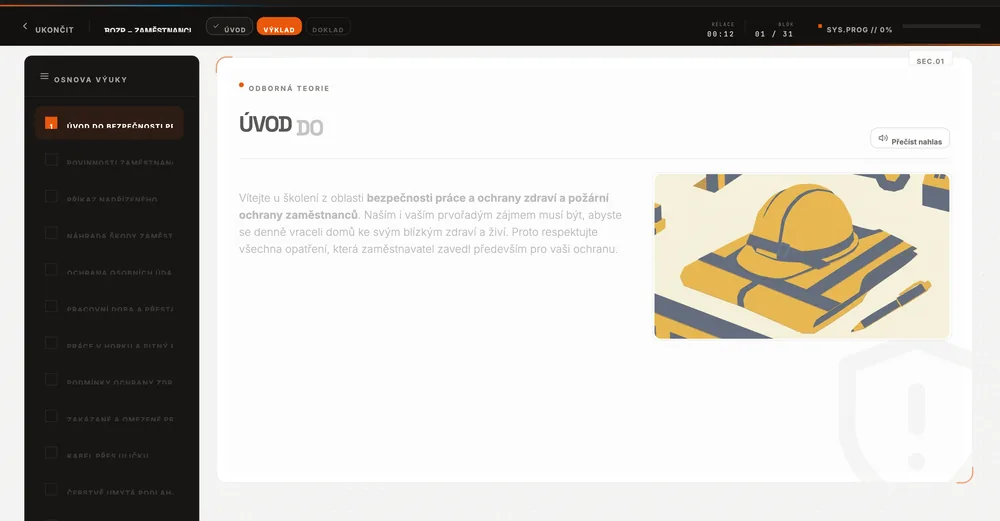
The course is not one video. It is a kit of blocks and each block has a condition for when it is shown. That is why two people from the same company see a different course — and both of them the right one.
Input
The person's position
From the records: the kind of position (shop floor / office / mixed), the risks, risk factors and work areas the position has on file.
Filter
A block appears only when both match
The kind of position (practical / admin) and at the same time a trigger from the records (risks · factors · areas). An office clerk with the factor “working posture” gets the block about sitting, not about lifting pallets.
Output
An outline made to measure — and on paper
The blocks that passed the filter make up the course outline. That same outline is then printed on the record — so the paper matches what the person actually saw.
Instead of “next, next, test”
25 kinds of block
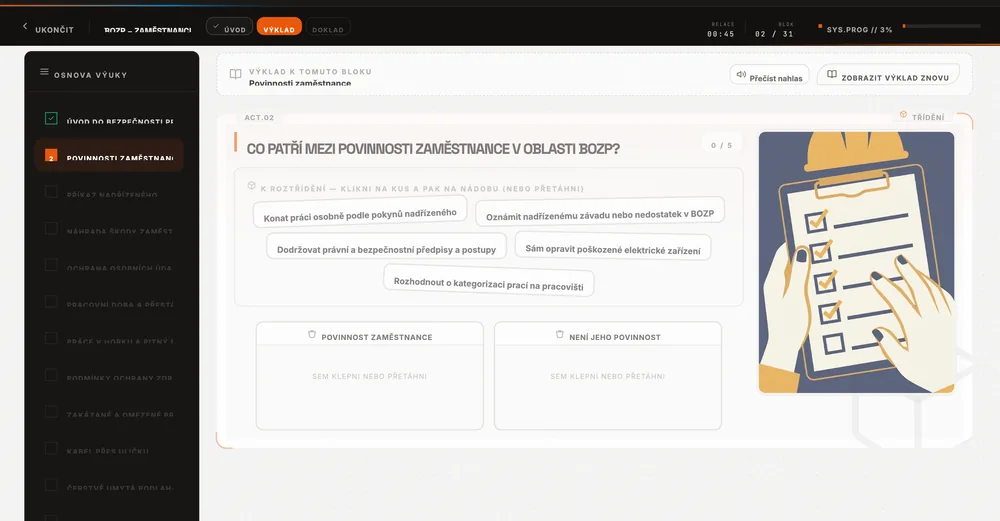
Explanation, video, quiz, scenario, myth busting, sorting, matching, picking from photographs, confirming a risk, choosing protective equipment, phishing, a story, categorisation, a category table, fill in the blanks, estimation, memory game, order of steps, spot the difference, labelling a picture, safe or unsafe, before and after, magnifier, chain of causes.
Questions are drawn from a pool, so no two people get the same test and copying makes no sense.
Who you are training
Three languages, one record
Czech, Ukrainian, English. A person takes the course in their own language; the record is in Czech — for the inspector and for your documentation.
Evidence
Time, device, signature
The system records time spent in the chapters, the date and time of completion, the IP address and device, the test result and a signature (with a finger on a phone or an electronic confirmation). The record carries a reference number and a QR code — scanning it verifies the record against the database, so it cannot be altered or produced afterwards.
03 · what comes out of the course
Documents, not certificates
Everything below is created automatically when the course is completed and filed in the company archive — where you already keep reports from inspections, audits and equipment checks.
Record of completed training
under § 103 of the Labour Code
| Employee | name, position |
| Title of training | and its scope |
| Date and time | of completion |
| Result | knowledge check (% and threshold) |
| Valid until | by the course interval |
01 · Course outline
The points the person actually went through
02 · Legal basis of the training
The regulations behind each part of the content
03 · Declarations and signatures
Employee + certified specialist, signed on screen
Issued electronically · record no. … · IP … [QR verification]
Training record
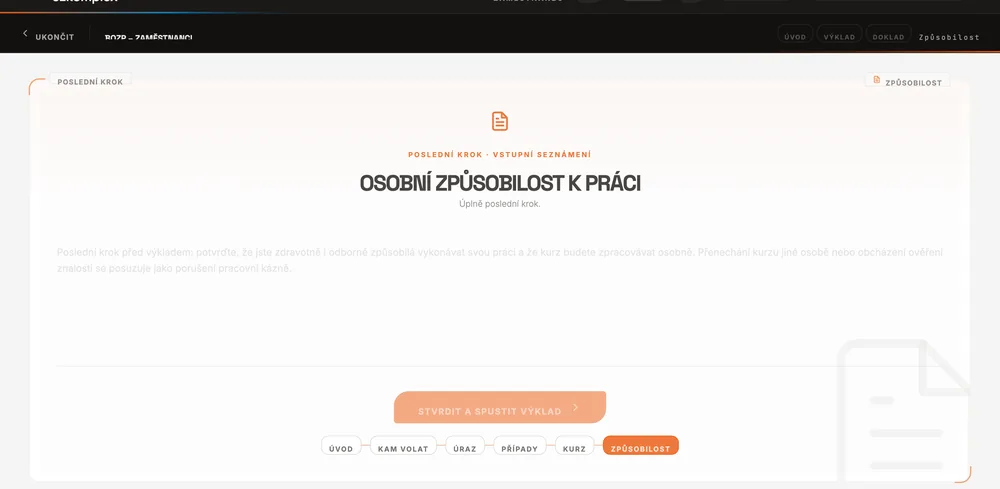
Created on completion, filed in the company archive, printable again at any time. The QR code on it verifies the record against the database.
Familiarisation with your documents
The course can include opening your internal rule or risk register — with proof that the person really opened and confirmed it.
Starter pack for a new employee
Job categorisation, protective equipment, prohibitions, a risk declaration, consent to data processing and the basis for the medical check — prefilled from data already in the system.
Records and deadlines
The training entry carries over to the employee and into the deadline overview — so you know whose training expires before it expires.
04 · two ways
With us, or on your own
The same e-learning, two ways to get to it. Becoming a client is the cheaper one — the course is then part of the agenda we run for you.
With us · a CZKOMPLEX client
Training as part of the agenda
We set the courses up from your risk register and positions, we watch the validity, and the records sit in the archive next to reports from audits and inspections. You only approve.
| employee | 95 |
| manager | 250 |
CZK per person, excl. VAT. Part of the client portal.
On your own · no contract, on a company ID
Self-service with credits
You open an account, get 150 credits free and send the courses to your people yourself. You fill in the positions and risks, the records stay in your account. When the credits run out, you top them up by card.
| safety – employees (35 credits) | ≈ 170 |
| first aid (10 credits) | ≈ 49 |
CZK per person, excl. VAT, when topping up. The first ≈ 4 people in the safety course are free.
Why is self-service dearer per person? Because there you do the work we would otherwise do — setting it up by risk, watching the deadlines, the paperwork around it. The course itself is the same service in both cases; what differs is how much of our work goes with it.
05 · free on top
11 document templates
The forms we use at clients — induction training, protective equipment records, checks of racking and ladders, accidents, handing over a vehicle. Fillable PDFs in Czech; the first one downloads without registration.
06 · comparison
Same price, different outcome
We are not cheaper — we are in the same band as ordinary online courses. The difference is what you are left holding when an inspection arrives.
| An ordinary online course | CZKOMPLEX | |
|---|---|---|
| Course content | one for everybody | blocks by position and by the risks you have on record |
| Test | a fixed set of questions | drawn from a pool — everyone gets a different set |
| What comes out | a certificate with a name | a record under § 103: outline, scope, legal basis, signature, validity |
| Verifying the record | — | a QR code on the record, verified against the database |
| Familiarisation with your documents | — | part of the course, with proof of opening and confirmation |
| Where the record is filed | in the employee's e-mail | in the company archive, next to inspection and audit reports |
| Tracking deadlines | — | the date of the next training in the deadline overview |
| Languages | usually Czech only | Czech, Ukrainian, English — the record always in Czech |
| Price per person (safety) | CZK 90–250 | CZK 95 for clients · ≈ CZK 170 in self-service — and the first few people free |
Competitor prices: public price lists of Czech providers of online safety training, as of September 2026, for orders of up to ten people.
07 · try it
Go through it yourself first
You do not have to take our word for it. Open an account on your company ID, send the course to yourself or to a few people and look at what comes out. Free, no strings — and nobody will call you.